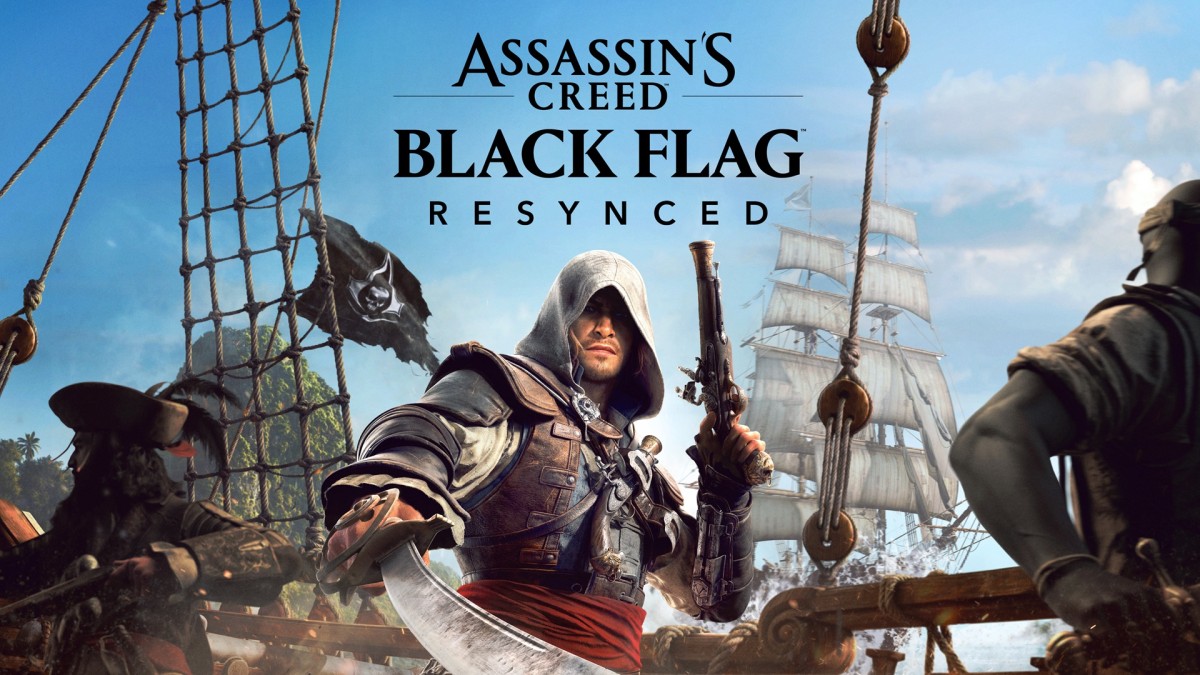
Ubisoft rebuilds the Caribbean. What does "preservation" mean when the object is a game we already knew by heart?
Some games we remember for their story. Others for their mechanics. Others for the era in which they came out. Assassin's Creed IV: Black Flag belongs to a rarer category: it is one of those games many people remember as a feeling.
The moment the Jackdaw heads out to sea. The sound of the waves. The crew's songs. The horizon that always seemed to promise something more. An island, a shipwreck, a ship to plunder, a treasure map, a story you did not expect to find.
Assassin's Creed Black Flag Resynced returns to that feeling, not simply to polish it, but to bring it closer to today's player. And that is its most interesting quality. It does not feel like a remake that exists only to remind us we once loved something. It feels like an attempt to reopen an old journey, removing much of what weighed it down and strengthening what made it stand out.
Edward Kenway remains one of the most distinctive protagonists in the series. He does not start out as a hero, nor as an idealist. He does not carry the weight of a great mission from the beginning. He is a man chasing his fortune, often in the wrong way, in a world where freedom and greed seem dangerously close to one another. That ambiguity is what makes him interesting. Edward enters the story of the Assassins and the Templars not out of belief, but out of coincidence, ambition and survival.
Black Flag always worked best when it let that pirate identity breathe. When it did not try to over-explain the series' larger mythology, but let you live inside the Caribbean instead. Resynced appears to understand this. It trims the points that used to break the rhythm, such as the long interruptions outside the period and the more tiresome tailing missions, and leaves more room for what we actually remember from the game: the adventure.
The renewed Caribbean is the first thing that impresses. Not only because it is visually richer, but because it rebuilds the atmosphere of the original game in greater detail. The light on the water, the tropical storms, the towns, the islands and the small stops between the big missions compose a world that does not merely work as a backdrop. It works as memory. Like seeing something you remember well, this time in a clearer picture.
And then there is the sea. That is where the game still finds its purest self. The Jackdaw is not simply a means of transport. It is an extension of Edward and, in the end, of the player. Naval combat, boarding, upgrading the ship, the routes between storms and enemy patrols remain the heart of the experience. No long explanations are needed. You see a ship on the horizon and decide whether to let it pass or to hunt it. That small decision contains all the charm of Black Flag.
On land, Resynced tries to make Edward more agile and more responsive. The parkour is smoother, the movement less rigid and the fights more spectacular. Combat now has better rhythm, more intensity and more options, without turning the game into something foreign to its original nature. It is still Assassin's Creed, but with less dust on it.
What matters is that the game does not try to become a new Odyssey or a new Valhalla. It does not load the experience with excessive systems, levels and endless progression mechanics. It stays cleaner, more focused and, in a way, freer. Today that seems almost paradoxical. In an era when many open world games constantly ask the player to manage something, Black Flag Resynced recalls the pleasure of travelling simply because you want to see what lies further on.
That does not mean the remake completely hides the age of the original design. There are moments where the old structures show under the new surface. Some missions remain simpler than one would expect today, some transitions in the narrative feel abrupt, while certain elements of the artificial intelligence and the animation are a reminder that the game's foundation comes from another era. But these do not cancel out the experience. On the contrary, in places they work almost as a reminder of where it came from.
And here lies the greatest interest of Resynced for a column like this one. It is not only whether the game "plays well" in 2026. It is how a game from 2013 can return without getting lost inside the modern logic of the remake. Black Flag Resynced does not try to erase its past. It rearranges it. It keeps the memory, but makes it accessible again.
Seen that way, it also has a small museum dimension. It reminds us that preserving video games is not only about saving the old editions, the boxes, the consoles and the discs. It is also about how we return to these works. How we reread them. How we present them to new players who had no connection at all with the time of their original release. A remake can be a commercial move, but it can also become a bridge between two generations of experience.
Assassin's Creed Black Flag Resynced is not a flawless game. It is, however, a remake with a clear direction and respect for the feeling of the original. Where other remakes try to impress by changing everything, this one seems to understand that the value of Black Flag always lay in its atmosphere, its rhythm and its sense of freedom.
And when, after hours, you find yourself back at sea, with the crew singing and the sun setting behind the horizon, it becomes clear why this game returned. Not simply because it had to be refreshed. But because this pirate fantasy, when it works properly, remains rare.
Black Flag Resynced is a return to a world many players never forgot. And for those travelling with Edward Kenway for the first time, it is perhaps the best moment to board the Jackdaw and understand why, all these years later, the Caribbean of Assassin's Creed still calls to us.